Hyundai Palisade (LX2): Coupling Assembly / Pressure Sensor
Description and operation
The AWD ECU makes a Motor Pump(Actuator) turn round for generating an oil pressure.
And then it presses a multiple disk clutch and transfers the generated torque
into rear wheels. Its torque value varies according to a pressure status.
| • |
Component location
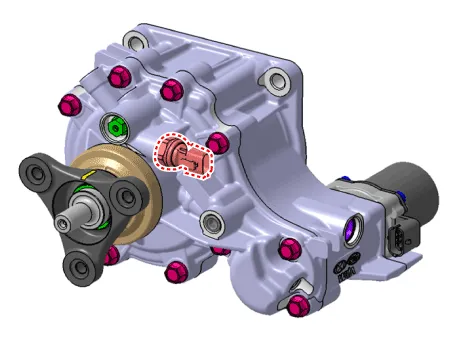
|
Schematic diagrams
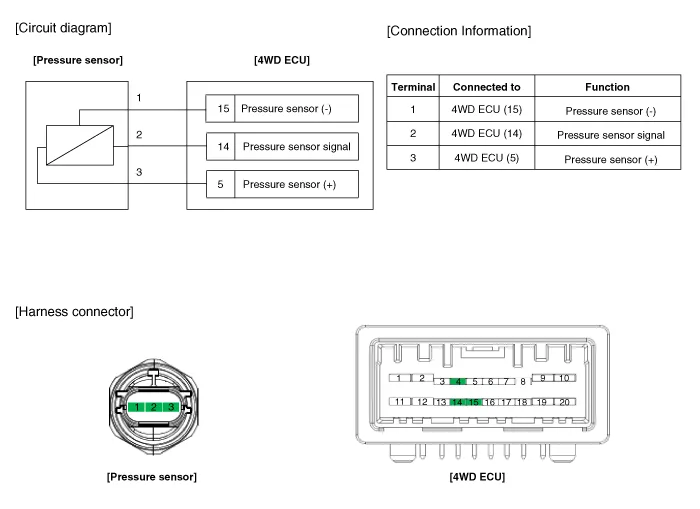
Repair procedures
| Measure the resistance of pressure
sensor |
| 1. |
Turn ignition switch OFF.
|
| 2. |
Disconnect the pressure sensor connector.
|
| 3. |
Measure resistance between sensor terminal and terminal.
|
| 4. |
Check the measured resistance. (Refer to table)
|
[Table 1]
Terminal
|
Resistance
|
PIN 2 – PIN 3
|
153.2 - 255.36 kΩ
|
PIN 1 – PIN 3
|
50.3 - 75.6 kΩ
|
PIN 1 – PIN 2
|
123.36 - 328.56 kΩ
|
| 1. |
Remove the coupling assembly.
(Refer to 4 Wheel Drive (AWD) System - "Coupling Assembly")
| •
|
Keep it level with the sticker (A) on the top of the
coupling.
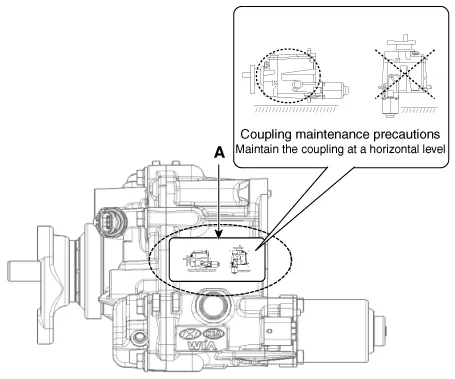
|
|
|
| 2. |
Remove the pressure sensor (A).
| •
|
Keep going horizontal state to prevent leaks during
remove the pressure sensor.
|
|
|
Tightening torque:
10.8 - 14.7 N.m (1.1 - 1.5 kgf.m, 8.0 - 10.8 lb-ft)
|

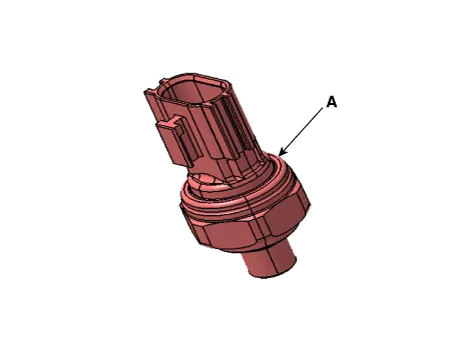
|
| 1. |
To install, reverse the removal procedure.
|
| • |
Check the cleanliness of the pressure sensor before installation.
|
| • |
Check the pressure sensor O-ring (A).
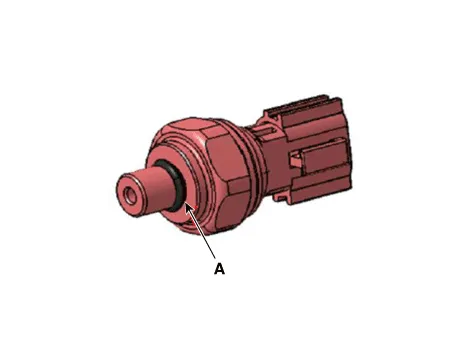
|
| • |
Keep it level with the sticker (A) on the top of the coupling.
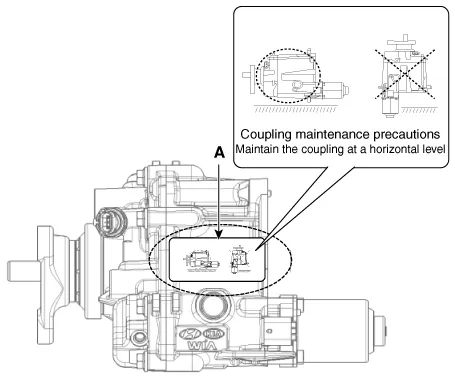
|
|
Description and operation
Description
The AWD ECM controls the Pump Motor Pump (Actuator) to generating an oil pressure.
The pressure engages a multiple disk clutch to transfer torque to the rear wheels.
Description and operation
Description
When the pressure inside the coupling exceeds the set pressure value, this valve
maintains the pressure under the set value by discharging the partial or whole
amount.
Other information:
Components and positions
Components
Circuit diagram
Circuit Diagram
Repair procedures
Removal
Handling wireless charging system parts by wet hands may cause electric
shock.
Description and operation
Description
The In-car air temperature sensor is built in the heater & A/C control unit.
The sensor consists of a thermistor that measures the inside temperature. The
signal decided by the resistance value that changes in accordance with perceived
inside temperature, is delivered to heater co