
Hyundai Palisade (LX2): Gauges and Meters / Fuel gauge

â– Type A and B
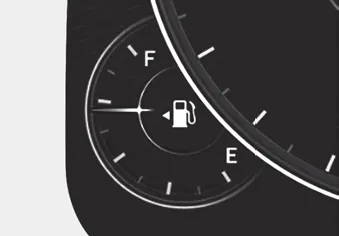
â– Type C
This gauge indicates the approximate amount of fuel remaining in the fuel tank.
Information
- The fuel tank capacity is given in chapter 8.
- The fuel gauge is supplemented by a low fuel warning light, which will illuminate when the fuel tank is nearly empty.
- On inclines or curves, the fuel gauge pointer may fluctuate or the low fuel warning light may come on earlier than usual due to the movement of fuel in the tank.
WARNING
Running out of fuel can expose vehicle occupants to danger.
You must stop and obtain additional fuel as soon as possible after the warning light comes on or when the gauge indicator comes close to the "E (Empty)" level.
NOTICE
Avoid driving with an extremely low fuel level. Running out of fuel could cause the engine to misfire damaging the catalytic converter.
â– Type A and B â– Type C This gauge indicates the temperature of the engine coolant when the ignition switch is in the ON position. NOTICE If the gauge pointer moves beyond the normal range area toward the "H" position, it indicates overheating that may damage the engine.
This gauge indicates the current outside air temperature by 1 degrees F (1 degrees C). - Temperature range : -40°F ~ 140°F (-40°C ~ 60°C) Note that the temperature indicated on the LCD display may not change as quickly as the outside temperature (there may be a slight delay before the temperature changes.
Other information:
Hyundai Palisade (LX2) 2020-2026 Service Manual: Warning Indicator
Components and components location Components 1. Warning indicator 2. SVM camera Repair procedures Removal 1. Disconnect the negative (-) battery terminal. 2.
Hyundai Palisade (LX2) 2020-2026 Service Manual: Surround View Monitor (SVM) Unit
Components and components location Components No Connector A 1 ACC 2 LED 3 EXT Ground 4 Y Shield 5 - 6 C-CAN Low 7
Categories
- Manuals Home
- Hyundai Palisade Owners Manual
- Hyundai Palisade Service Manual
- Identification Numbers
- Troubleshooting
- Electrochromatic Mirror (ECM) with homelink system
- New on site
- Most important about car
