
Hyundai Palisade (LX2): Charging System / Alternator
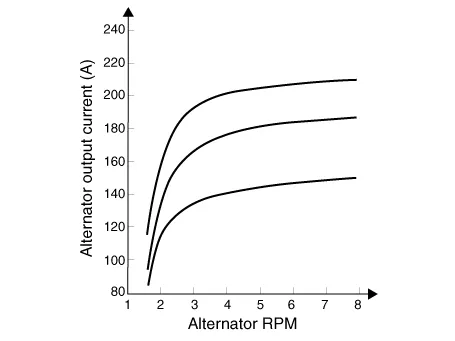
Specifications
| Specification |
|
Item |
Specification |
|
Rated voltage |
13.5V , 180A |
|
Speed in use |
1,500 - 18,000rpm |
|
Voltage regulator |
IC Regulator built in type |
|
Default regulated voltage (V) [COM terminal] |
14.09 - 14.91 (-35°C) |
|
13.96 - 15.04 (140°C) |
|
|
Pin |
1 |
Description and operation
| Description |
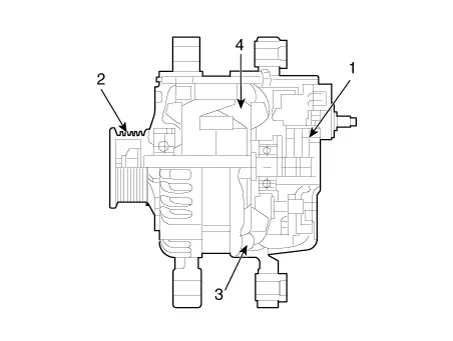
| 1. Brush 2. Drive belt pully 3. Rotor 4. Stator |
Schematic diagrams
| Circuit Diagram |
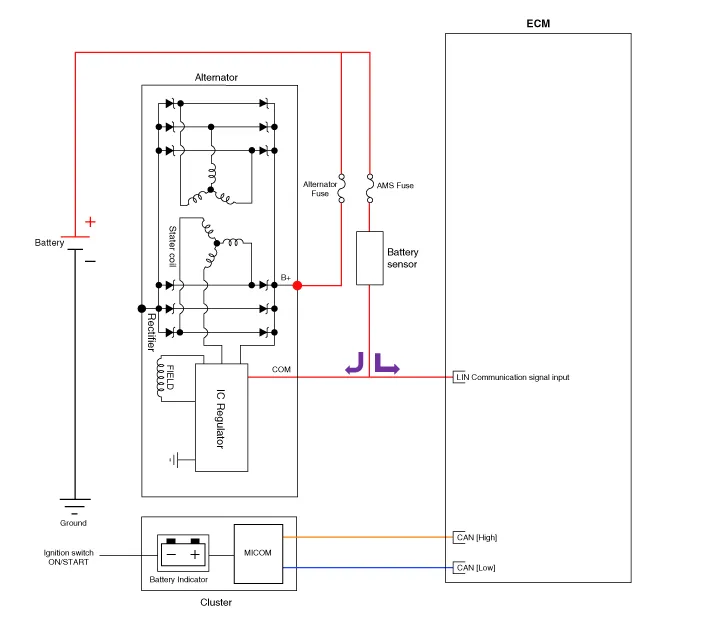
|

Repair procedures
| Removal |
| 1. |
Turn ignition switch OFF and disconnect the battery negative (-) terminal.
|
| 2. |
Remove the alternator mounting nut, and then remove the cable(A) from
alternator "B" terminal.
|
| 3. |
Disconnect the alternator connector (B).
|
| 4. |
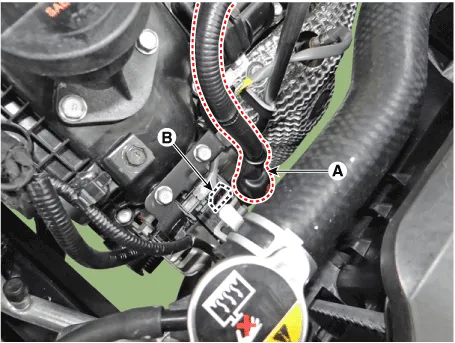
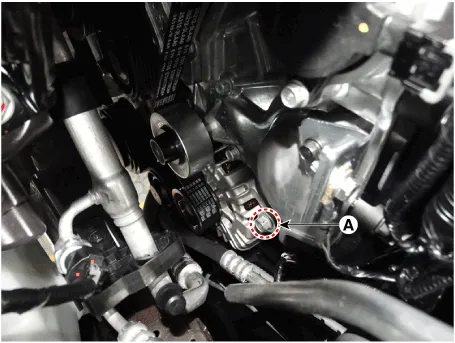
Remove the alternatir upper bolt (A).
|
| 5. |
Lift the vehicle.
|
| 6. |
Remove the engine room under cover.
(Refer to Engine Mechanical System - "Engine Room Under Cover")
|
| 7. |
Remove the drive belt.
(Refer to Engine Mechanical System - "Drive Belt")
|
| 8. |
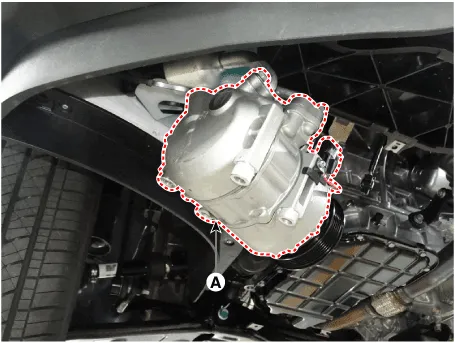
Disconnect the compressor ECV connector, and then by loosening the mounting
bolts, widen the gap between the compressor (A) from the engine to remove
the alternator.
|
| 9. |
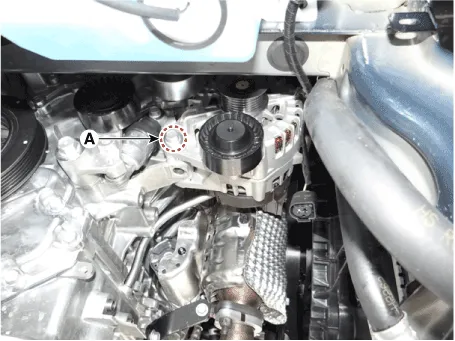
Remove the alternator lower bolt (A).
|
| 10. |
Remove the alternator (A).
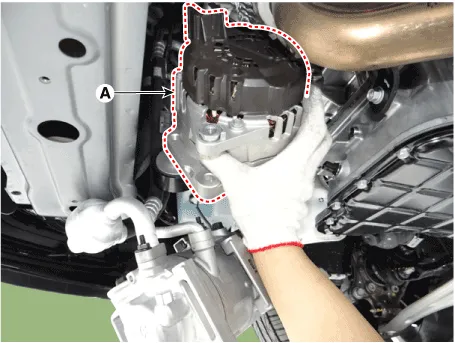
|
| Installation |
| 1. |
Install in the reverse order of removal.
|
| 2. |
Install the drive belt.
(Refer to Engine Mechanical System - "Drive Belt")
|
Troubleshooting • Be careful not to short-circuit the wiring by the body or other wirings.
Specifications Specification Item Specification Model type AGM80L-BCI Capacity [20HR/5HR] (AH) 80/64 Cold Cranking Amperage (A) 800 (SAE) / 640 (EN) Reserve Capacity (Min) 155 ▷CMF68L-DIN Item Specification Capacity [20HR / 5HR] (AH) 68 / 54 Cold Cranking Amperage (A) 600 (SAE / EN) Reserve Capacity (Min) 113 ▷CMF80L-DIN Item Specification Capacity [20HR / 5HR] (AH) 80 / 64 Cold Cranking Amperage (A) 660 (SAE / EN) Reserve Capacity (Min) 145 ▷CMF90L-DIN Item Specification Capacity [20HR / 5HR] (AH) 90 / 72 Cold Cranking Amperage (A) 740 (SAE) / 740 (EN) Reserve Capacity (Min) 170 ▷CMF68L-DIN [Openable] Item Specification Capacity [20HR / 5HR] (AH) 68 / 54 Cold Cranking Amperage (A) 600 (SAE / EN) Reserve Capacity (Min) 113 ▷CMF80L-DIN [Openable] Item Specification Capacity [20HR / 5HR] (AH) 80 / 64 Cold Cranking Amperage (A) 660 (SAE / EN) Reserve Capacity (Min) 145 ▷CMF90L-DIN [Openable] Item Specification Capacity [20HR / 5HR] (AH) 90 / 72 Cold Cranking Amperage (A) 740 (SAE) / 740 (EN) Reserve Capacity (Min) 170 • Model type description • Cold Cranking Ampere (CCA) : A rating used in the battery industry to define a battery's ability to start an engine in cold temperatures.
Other information:
Hyundai Palisade (LX2) 2020-2026 Service Manual: Antenna Coil
Repair procedures Removal 1. Disconnect the negative (-) battery terminal. 2. Remove the crash pad lower panel. (Refer to Body - "Crash Pad Lower Panel") 3.
Hyundai Palisade (LX2) 2020-2026 Service Manual: Heater Core
Repair procedures Replacement 1. Disconnect the negative (-) battery terminal. 2. Remove the heater and blower assembly. (Refer to Heater - "Heater Unit") 3.
Categories
- Manuals Home
- Hyundai Palisade Owners Manual
- Hyundai Palisade Service Manual
- Components and components location
- Engine Control/Fuel System
- Emergency liftgate safety release
- New on site
- Most important about car
