
Hyundai Palisade (LX2): Fuel Delivery System / High Pressure Fuel Pump
Repair procedures
| Removal |
| 1. |
Release the residual pressure in fuel line.
(Refer to Fuel Delivery System - "Release Residual Pressure in Fuel
Line")
|
| 2. |
Switch "OFF" the ignition and disconnect the negative (-) battery terminal.
|
| 3. |
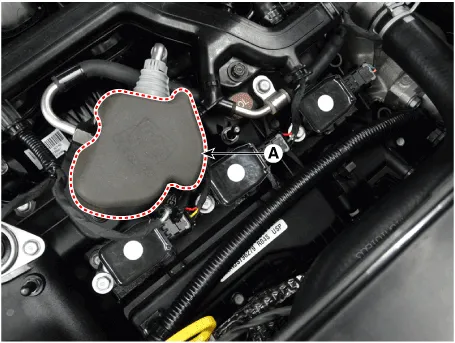
Remove the high pressure fuel pump foam (A).
|
| 4. |
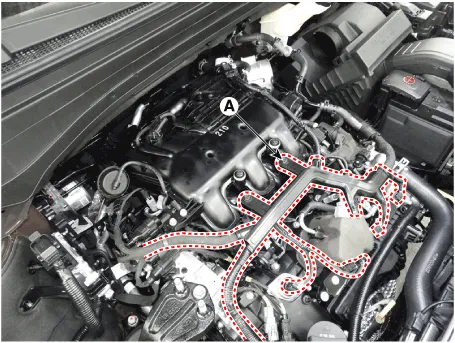
Remove the control wiring harness (A).
|
| 5. |
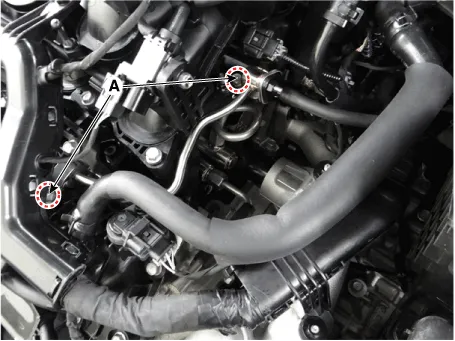
Remove the fuel line mounting bolts (A).
|
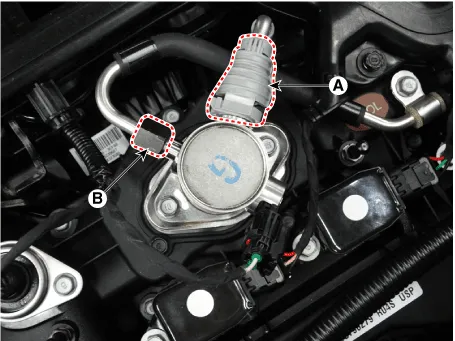
| 6. |
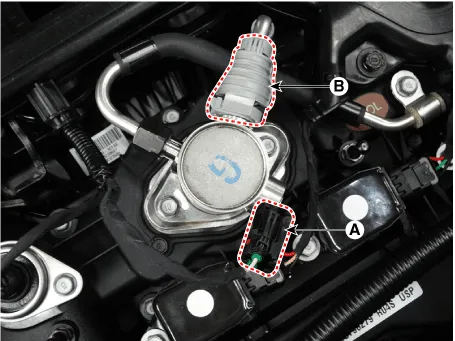
Disconnect the high pressure fuel control valve connector (A) and low
pressure fuel feed tube quick-connector (B).
|
| 7. |
Remove the high pressure fuel pipe.
(Refer to Fuel Delivery System - "Fuel Line")
|
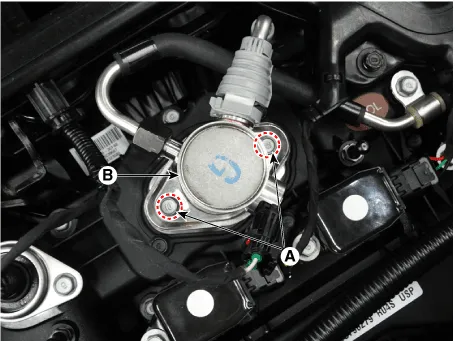
| 8. |
Remove the mounting bolts (A), and then remove the high pressure fuel
pump (B) from the cylinder head assembly.
|

| Installation |
|

|

|

|

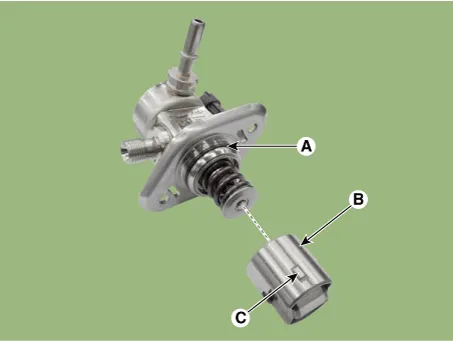
| 1. |
Install in the reverse order of removal.
|
Repair procedures Removal • When removing the high pressure fuel pump, high pressure fuel pipe, delivery pipe, and injector, injury may be caused by leakage of high pressure fuel.
Other information:
Hyundai Palisade (LX2) 2020-2026 Service Manual: Repair procedures
Refrigerant System Service Basics (R-134a) Refrigerant Recovery Use only service equipment that is U.L-listed and is certified to meet the requirements of SAE J2210 to remove HFC-134a(R-134a) from the air conditioning system.
Hyundai Palisade (LX2) 2020-2026 Service Manual: PTC Heater (Diesel only)
Description and operation Description The PTC (Positive Temperature Coefficient) heater is installed at the exit or the backside of the heater core. The PTC heater is an electric heater using a PTC element as an auxiliary heating device that supplements deficiency of interior heat source in highly effective diesel engi
Categories
- Manuals Home
- Hyundai Palisade Owners Manual
- Hyundai Palisade Service Manual
- Electrochromatic Mirror (ECM) with homelink system
- Body Electrical System
- Lift and Support Points
- New on site
- Most important about car
