
Hyundai Palisade (LX2): Engine Control System / Oil Pressure Sensor (OPS)
Hyundai Palisade (LX2) 2020-2026 Service Manual / Engine Control/Fuel System / Engine Control System / Oil Pressure Sensor (OPS)
Description and operation
| Description |
Continuous Variable Valve Timing (CVVT) system advances or retards the valve
timing of the intake and exhaust valve in accordance with the ECM control signal
which is calculated by the engine speed and load.
By controlling CVVT, the valve overlap or underlap occurs, which in turn improves
fuel efficiency, reduces exhaust gases (NOx, HC) and improves engine performance
by reducing pumping loss, generating internal EGR effect, improving combustion
stability and volumetric efficiency, and increasing expansion work.
This system consists of the CVVT Oil Control Valve (OCV) which supplies the
engine oil to the cam phaser or cuts the engine oil from the cam phaser in accordance
with the ECM PWM (Pulse With Modulation) control signal, the CVVT Oil Temperature
Sensor (OTS) which measures the engine oil temperature, and the Cam Phaser which
varies the cam phase by using the hydraulic force of the engine oil.
The engine oil which is supplied through the CVVT oil control valve varies the
cam phase in the direction (Intake Advance/Exhaust Retard) or opposite direction
(Intake Retard/Exhaust Advance) of the engine rotation by rotating the rotor
connected with the camshaft inside the cam phaser.
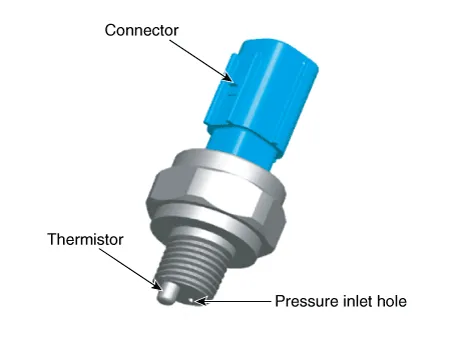
Specifications
| Specifications |
|
Pressure (Bar) |
Output Voltage (V) [Vref=5V] |
|
0 |
0.46 - 0.54 |
|
2 |
1.25 - 1.35 |
|
4 |
2.05 - 2.15 |
|
6 |
2.84 - 2.96 |
|
10 |
4.42 - 4.58 |
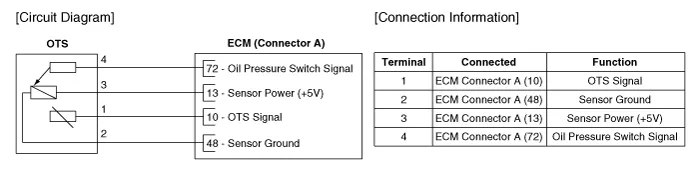
Schematic diagrams
| Circuit Diagram |
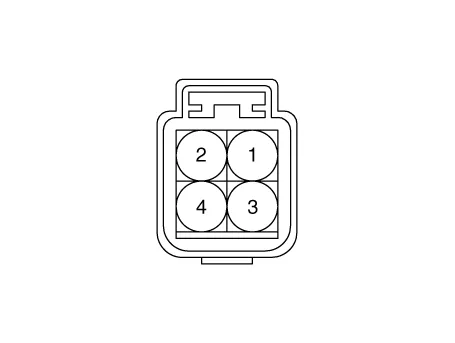
Harness Connector
Repair procedures
| Inspection |
| 1. |
Switch "OFF" the ignition.
|
| 2. |
Disconnect the OPS connector.
|
| 3. |
Remove the OPS.
|
| 4. |
After immersing the thermistor of the sensor into engine coolant, measure
resistance between the OPS terminals 2 and 4.
|
| 5. |
Check that the resistance is within the specification.
|
| Removal |
| 1. |
Refer to Engine Mechanical System - "Oil Pressure Sensor"
|
| Installation |
| 1. |
Refer to Engine Mechanical System - "Oil Pressure Sensor"
|
Description and operation Description Continuous Variable Valve Timing (CVVT) system advances or retards the valve timing of the intake and exhaust valve in accordance with the ECM control signal which is calculated by the engine speed and load.
Description and operation Description Installed on the accelerator pedal module, the Accelerator Position Sensor (APS) detects the rotation angle of the accelerator pedal.
Other information:
Hyundai Palisade (LX2) 2020-2026 Service Manual: Description and operation
Description The smart cruise control system allows a driver to program the vehicle to control the speed and following distance by detecting the vehicle ahead without depressing the brake pedal or the accelerator pedal. 1.
Hyundai Palisade (LX2) 2020-2026 Service Manual: Components and components location
Categories
- Manuals Home
- Hyundai Palisade Owners Manual
- Hyundai Palisade Service Manual
- Engine Electrical System
- Components and components location
- Identification Numbers
- New on site
- Most important about car

Copyright В© 2026 www.hpalisadelx.com - 0.0153