
Hyundai Palisade (LX2): Engine Control System / CVVT Oil Temperature Sensor (OTS)
Description and operation
| Description |

Specifications
| Specification |
|
Temperature |
Resistance (kΩ) |
|
|
°C |
°F |
|
|
-40 |
-40 |
41.74 - 54.54 |
|
-20 |
-4 |
14.13 - 16.83 |
|
0 |
32 |
5.28 - 6.3 |
|
25 |
77 |
1.88 - 2.14 |
|
80 |
176 |
0.31 - 0.33 |
|
140 |
284 |
0.07 - 0.08 |
Schematic diagrams
| Circuit Diagram |
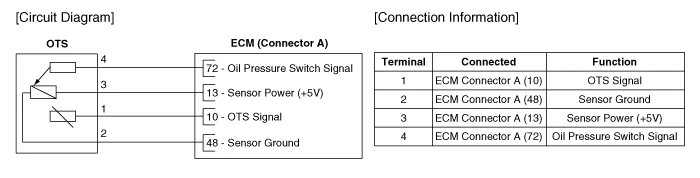
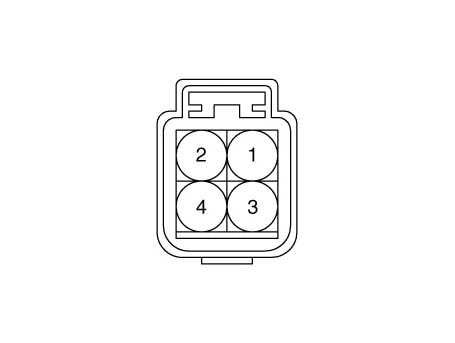
Repair procedures
| Inspection |
| 1. |
Switch "OFF" the ignition.
|
| 2. |
Disconnect the OTS connector.
|
| 3. |
Remove the OTS.
|
| 4. |
After immersing the thermistor of the sensor into engine coolant, measure
resistance between the OTS terminals 1 and 2.
|
| 5. |
Check that the resistance is within the specification.
|
|||||||||||||||||||||||
| Removal |
| 1. |
Refer to Engine Mechanical System - "Oil Pressure Sensor"
|
| Installation |
| 1. |
Refer to Engine Mechanical System - "Oil Pressure Sensor"
|
Description and operation Description Installed on the delivery pipe, the Rail Pressure Sensor (RPS) measures the instantaneous fuel pressure in the delivery pipe.
Description and operation Description Continuous Variable Valve Timing (CVVT) system advances or retards the valve timing of the intake and exhaust valve in accordance with the ECM control signal which is calculated by the engine speed and load.
Other information:
Hyundai Palisade (LX2) 2020-2026 Service Manual: Immobilizer Control Unit
Repair procedures Removal 1. Disconnect the negative (-) battery terminal. 2. Remove the glove box housing. (Refer to Body - "Glove Box Housing Cover") 3.
Hyundai Palisade (LX2) 2020-2026 Service Manual: Heater Core
Repair procedures Replacement 1. Disconnect the negative (-) battery terminal. 2. Remove the heater and blower assembly. (Refer to Heater - "Heater Unit") 3.
Categories
- Manuals Home
- Hyundai Palisade Owners Manual
- Hyundai Palisade Service Manual
- Removing and Storing the Spare Tire
- Body (Interior and Exterior)
- Scheduled maintenance services
- New on site
- Most important about car
